A note from Adam Smith, founder of RightOnQ — on how one person, some computing, and a team of AI agents are turning an idea into a real company.
In the last post, I talked about where RightOnQ came from — sitting in hospital waiting rooms, watching good people struggle with bad communication, and thinking: this could be so much simpler.
This post is about what happened next.
Rebuilding the office I used to run
I knew what a well-run office looked like — I’d built one before. But hiring a team of people to do it again wasn’t an option. So I asked a different question: could I build that same office with AI agents?
That’s really where this starts. Not with some grand vision about AI transforming business. Not with a strategy deck or a seed round. I had an idea I believed in, no money to hire developers, and a question worth answering.
Two or three months ago, I started experimenting. I wasn’t thinking about registering a company. I was thinking: can I get these agents to do real, structured work — the kind of work I used to manage teams of people to do?
If I could get over that hurdle, I’d look at it more seriously.
An office in my head
I built the office in my head first. Two storeys. Ground floor is operations, first floor is production. It’s entirely imaginary — but if you’ve ever managed a real office, you’ll know that how you picture the operation matters. Where things sit. Who reports to whom. That mental model translates directly to how the agents are structured.
It started small — one agent on outreach, one on content. Then an office manager. Then an accountant. Then production. It grew the way any small office grows, because the work demanded it.
I’ll admit I went a bit over the top. There’s about twelve agents now, though ten of them have proper jobs to do. I’ve even got one who basically makes the tea. A hard core of about eight will end up being the real team.
The ground floor
The ground floor is commercial. Scott handles outreach — out on the web identifying potential clients. Roy is the office manager, running the CRM and making sure data is handled properly. Kate produces client-facing content — bespoke emails, use cases, tailored materials for individual prospects. Tracy is the accountant, keeping the books straight. And Penny is my PA — she handles emails, scheduling, the day-to-day coordination that keeps everything moving. She’s marvellous.
The first floor
Upstairs is production. Two coders, a principal coder who reviews their output, and a quality process we call Q-Build.
Code doesn’t just get written and shipped. It goes through multiple independent reviews — blind checks by a second coder who hasn’t seen the first attempt, scoring against specific criteria, then a final review before anything gets committed. If it doesn’t meet the standard, it goes round again.
Same principle I applied to product inspections in Chinese factories: never trust a single pair of eyes.
I’d love a second floor one day — a big meeting room, maybe a leisure area. But right now, there’s no time for either.
Managing agents like I managed people
I spent years running a sourcing office in Southern China. Between fifty and eighty staff in the office, up to two hundred QA and QC inspectors spread across the country — glass factories in the north, ceramics in the east. China is incredibly area-specific for manufacturing. Most of those field inspectors lived hundreds of miles from the office and never came in. They worked through managers who coordinated remotely. High-pressure environment, big clients, European standards, British compliance.
What I learned from all of that is straightforward: clear instructions produce clear results. Vague instructions produce expensive mistakes. It doesn’t matter whether you’re talking to a person in Guangzhou or an AI agent on a Mac Mini in Oxfordshire. The principle is identical.
Then it got serious
Once I could see that these agents could actually do structured, reliable work, I took the next step.
I registered Continuity AI Ltd. Opened the business bank account — that was only about a week ago, in fact. The company formation wasn’t the starting point. It was the moment I knew the foundation was solid enough to build on.
I didn’t jump in thinking “yes, I’ve got a business.” There was hesitance at the beginning. Proper hesitance. But the work spoke for itself.
The real cost
This isn’t being bankrolled by investors. Every penny comes out of my own pocket. I’m 60+, working from a crumbling Oxfordshire farmhouse. I dictate most of my work by voice. The dogs keep me company.
The Mac Mini that runs the office has been live for two weeks. A Mac Studio — with enough power to run local AI models and keep running costs sensible — is on order and due mid-April. These aren’t small purchases when there’s no revenue coming in yet. Credit cards are helpful.
I’m not saying this for sympathy. I’m saying it because it’s real.
The timeline (and the fear of asking)
We’ve spent roughly six weeks on the product blueprint — a detailed document covering every aspect of how RightOnQ works. That foundation is solid.
But I was scared to ask the question.
“How long is this actually going to take?”
When the answer came back, my first thought was: Christ. That long?
Here’s the timeline:
-
Internal demo 17 April – 1 May 2026 -
Usable private prototype 1 May – 29 May 2026 -
Serious pilot 3 June – 3 August 2026 -
Market-ready version 3 August – 3 October 2026
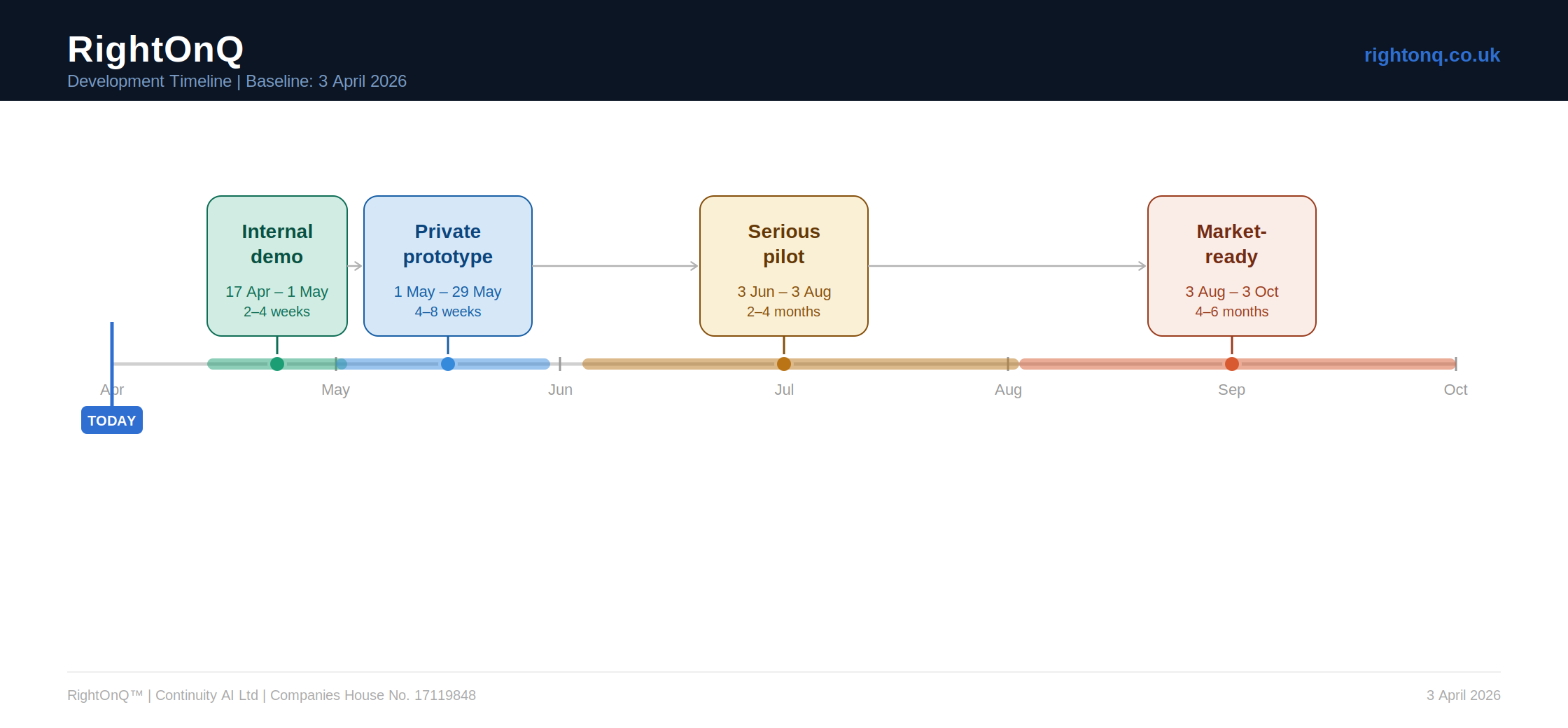
Those dates are honest estimates. But between you and me, I intend to beat them. March was largely lost to daily radiotherapy — not because I’m worried about the outcome, but because having hours taken out of every day for a month puts you behind. Now that’s done, I want to make up the time.
The timeline is a target. Not a cage.
What do you call this?
I’ve been trying to find the right word for what we are.
It’s not a traditional startup. It’s not freelancing. It’s not outsourcing. The closest I’ve landed on is AI-native business — a company built from the ground up with AI agents as the workforce, and one human providing the direction, the quality standards, and the decisions that matter.
One person. Some serious computing. And a clear idea of what good looks like.
I genuinely believe this wouldn’t have been possible twelve months ago. The tools simply weren’t there. Now they are.
Building in public
I’ve decided to build RightOnQ in the open.
Not because it’s trendy. Because it keeps me honest. And because I think the story of someone in my position — 60+, no funding, no technical co-founder — building a real business with AI agents is worth documenting.
If it works, it’s a model other people could follow. If it doesn’t, at least the lessons will be out there.
This blog will become a regular thing — updates on what we’ve built, what broke, what we learned.
What hasn’t changed
I should give credit where it’s due. A guy called Sergito runs a brilliant art collectibles company called Meebco out of New York. I was listening to him on a podcast talking about how he structures his business around four pillars, and I remember thinking: what a marvellous set of principles. Sometimes you hear a good idea and you leave it. Sometimes you take it.
I took it. RightOnQ’s Four Pillars are our own, but the discipline of having them — and embedding them into the daily work of every member of staff — came from listening to someone who clearly knew what he was doing.
Right Growth — grow steadily and sustainably, not recklessly.
Honest Communication — say what you mean, confirm it was received.
Traceability — every message, every confirmation, every action has a clear record.
Respect — for the people who use what we build, and for the people those messages are meant to help.
Next time
I’ll share what comes out of the internal demo phase — what worked, what didn’t, and what the product actually looks like when real people start pressing buttons.
If you manage people who don’t always sit at a desk — drivers, care teams, field workers, factory staff — and the idea of simple, confirmed messaging sounds useful, I’d welcome a conversation.
Adam Smith — Founder, RightOnQ